
Tension (Haploid Selection)
Neus Torres Tamarit and Ben Murray
Artwork for ‘Tension‘ (Issue 23)
The Science
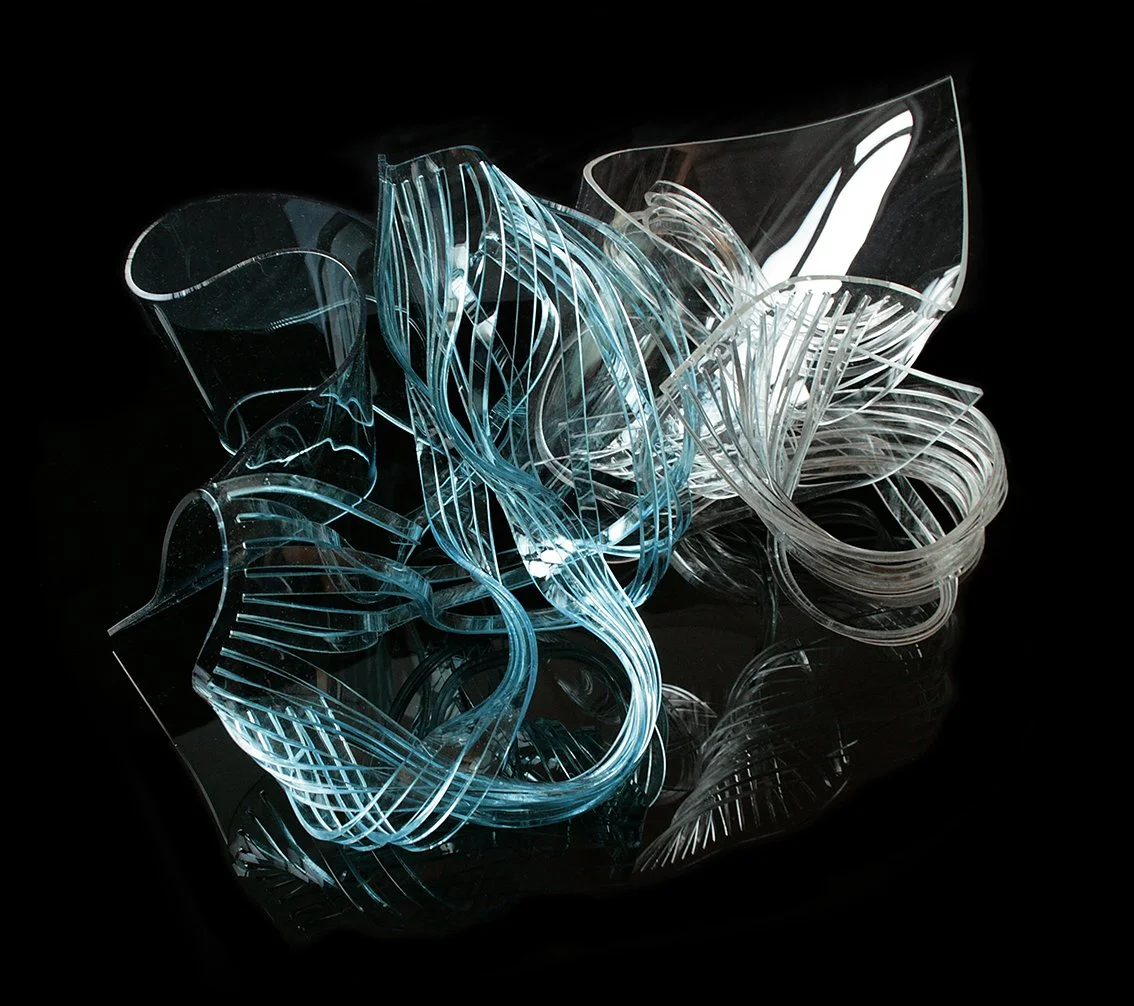
‘Tension (Haploid Selection)’ is a sculpture exploring evolutionary pressure on gametes (eggs and sperm). It responds to Dr Simone Immler's research on haploid selection using zebrafish (Danio rerio) at University of East Anglia.
Sexually-reproducing species briefly exist as two haploid organisms (gametes with single chromosome sets). Research shows that gametes express their DNA, relating to the DNA expression in resulting lifeforms. Due to external fertilization, zebrafish gametes undergo extreme environmental pressure, caught between conflicting selective forces; a state the sculpture's material tension embodies.
Dr Immler studies how evolutionary selection on zebrafish sperm conflicts with selection on the offspring they create.
The Medium
Made from laser-cut acrylic heated and bent by hand, each sculpture part is under physical tension, metaphorically representing environmental and evolutionary pressure on gametes. The hand-applied force mirrors these pressures: as the heated material adapts to the frame's constraints, the artist cannot fully control its final shape, reflecting how gametes must adapt to immediate environmental conditions while being subject to selective forces that determine their success.
The Artists
Neus Torres Tamarit is a multimedia artist and curator, and Ben Murray is a data scientist. They co-founded Phenotypica (Art & Science) in 2016, to explore the intersections of art, science, technology, and artificial intelligence through immersive installations and public engagement. Their objective is to bridge the communication gap between scientific research and the general public by creating visual languages about complex scientific topics that invite interaction and conversation.
They’ve worked with leading institutions including The Royal Society, The Francis Crick Institute, Wellcome Trust, Cardiff University, University College London, The National Gallery X, and Tate Modern.
Copyright statement. This work is published under the CC BY-NC-SA license